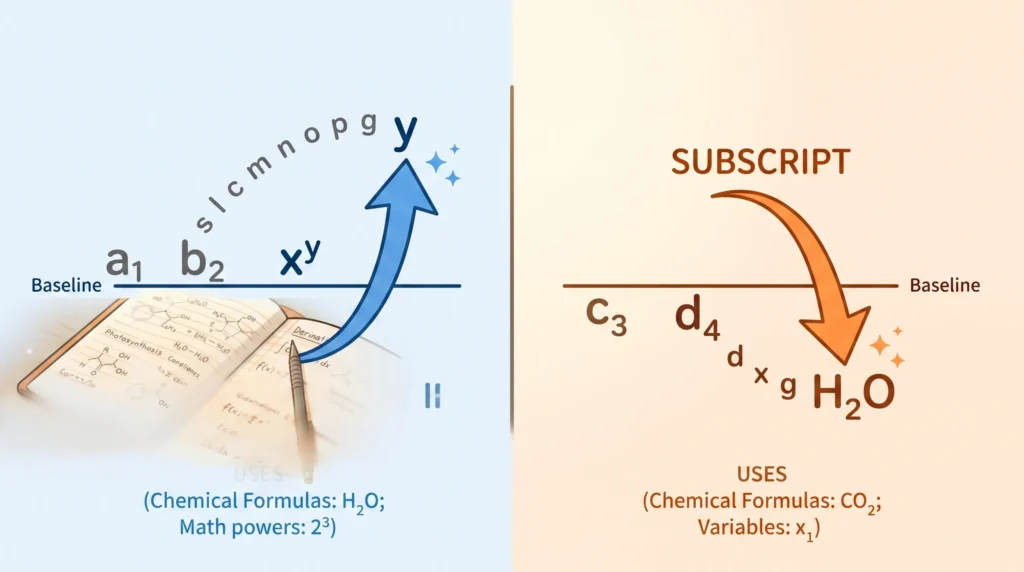
Superscript and subscript both raise or lower part of your text, but comparing superscript vs subscript side by side shows they solve different problems. One sits above the baseline for exponents and footnotes, the other sits below it for chemical formulas and technical notation. This guide breaks down superscript vs subscript so you always know which one to reach for.
Table of Contents
The Quick Answer
Superscript and subscript both shrink a character down, but they move it in opposite directions relative to the normal line of text. Superscript lifts it up, like the “2” in x². Subscript drops it down, like the “2” in H₂O. That’s the whole distinction in one sentence — but knowing which one to reach for, and why, takes a bit more context.
Superscript: When a Character Belongs Above the Line
Superscript is the one most people recognize on sight, because it shows up constantly in everyday writing. Exponents are the clearest example: 10³ means 10 multiplied by itself three times, and the raised “3” is what tells you that. Ordinal numbers use it too — 1ˢᵗ, 2ⁿᵈ, and 3ʳᵈ all rely on a small raised suffix to read correctly. You’ll also spot it after brand names as a trademark or registered mark, and in footnote references sprinkled through academic or long-form writing. Even casual social captions borrow the look occasionally, using a tiny raised word or symbol purely because it draws the eye differently than a normal line of text.
The unifying idea behind superscript is that the raised character is modifying or annotating the one before it — a power, a rank, a legal mark, or a pointer to more information elsewhere, a distinction worth remembering when weighing superscript vs subscript.
Subscript: When a Character Belongs Below the Line
Subscript solves a different kind of problem. It’s almost exclusively associated with chemistry and mathematics, where a lowered number identifies a quantity or a specific element in a sequence rather than modifying a value. In H₂O, the lowered “2” tells you there are two hydrogen atoms in the molecule — it’s a count, not an exponent. In a mathematical sequence like x₁, x₂, x₃, the lowered numbers simply label which term in the list you’re referring to. Logarithm bases, such as the “2” in log₂(8), follow the same pattern.
If superscript tends to answer “how much” or “which power,” subscript tends to answer “which specific instance.”, a distinction worth remembering when weighing superscript vs subscript.
A Few Situations People Regularly Mix Up
Because both styles shrink text, it’s easy to reach for the wrong one under time pressure. A few patterns are worth remembering:
- Exponents and powers (x², 10⁻³) always use superscript, never subscript
- Chemical formula counts (H₂O, CO₂) always use subscript, never superscript
- Ordinal endings (1st, 2nd, 3rd) are superscript when stylized
- Footnote markers in text are conventionally superscript, while citation-style reference numbers in some formats sit as subscript instead
- Ionic charges in chemistry, like Na⁺, actually use superscript for the charge even though the rest of the formula uses subscript for atom counts
That last one trips up a lot of chemistry students specifically, since a single formula can legitimately need both styles at once. A good rule of thumb: if the small character is telling you how many times something is multiplied, raise it. If it’s telling you how many of something exists within a larger unit, lower it, a distinction worth remembering when weighing superscript vs subscript.
Typing Either One Without a Word Processor
The reason this distinction matters practically, rather than just academically, is that most everyday text fields — social bios, chat apps, comment sections — don’t support the formatting buttons you’d use in Word or Google Docs. If you need a real exponent for a physics problem, our superscript generator built for exponents and footnotes converts ordinary numbers into genuine raised Unicode characters that paste correctly anywhere. If you’re instead writing out a chemical formula or a subscripted sequence, the companion subscript generator guide for chemistry and math notation covers the lowered-text side in more depth, including which characters Unicode does and doesn’t support.
Both tools work the same basic way: you type normal text, the generator swaps in the matching small Unicode character, and you copy the result wherever you need it — no rich text formatting required, a distinction worth remembering when weighing superscript vs subscript.
The Unicode Reality Behind Both Styles
It helps to understand that both superscript and subscript, in this copy-paste form, rely on a limited set of dedicated Unicode characters rather than a universal “shrink and move” function. Wikipedia’s article on subscript and superscript lays out how the standard grew mostly around scientific typesetting, which is why full alphabetic coverage still doesn’t exist for either style. When you’re working directly in HTML instead of plain text, browsers handle this differently and natively — MDN’s page on the sup element explains how real superscript tags render without needing special characters at all.
Not Every Small Text Trick Is About Function
It’s worth noting that not all Unicode text tricks are trying to convey meaning the way superscript and subscript do. Some are purely stylistic or even used to create blank-looking space, like the tools covered in our piece on invisible and blank text for Discord, PUBG, and Free Fire names. Superscript and subscript are functional first and stylish second; that piece is almost the opposite, which sums up superscript vs subscript in practice.
Once you know which direction you actually need, picking the right generator takes seconds. Bookmark both tools so whichever one comes up — a physics exponent or a chemistry formula — you’re never stuck fighting with a formatting menu that doesn’t work where you’re pasting. Start with the superscript generator if raised text is what you need right now, and switch over the moment a formula calls for the opposite direction instead, which sums up superscript vs subscript in practice.
Frequently Asked Questions
What’s the core difference in superscript vs subscript?
Superscript characters sit raised above the normal text line, the style used for exponents and footnote markers. Subscript characters sit lowered below the line instead, which is what chemistry formulas and some math notation need. That position is the whole story behind superscript vs subscript.
How do I know which to use, superscript vs subscript?
Let the notation decide. Exponents, footnotes, and ordinal endings like 2nd call for superscript, while chemical formulas like H2O and some math subscripts call for subscript. Matching the convention people already expect keeps your writing easy to read.
Can superscript and subscript appear in the same line of text?
Yes, and it’s common in real notation, such as an isotope symbol that uses both a superscript mass number and a subscript atomic number. Mixing superscript vs subscript in one line is normal wherever the underlying notation calls for it.